Search this site
1360 results found with an empty search
- Hermann's Tortoise (Testudo hermanni)
The Hermann's Tortoise (Testudo hermanni) is a small, land-dwelling reptile native to Southern Europe, including Greece. It has a high-domed, yellow-brown shell with dark, black patches and a slightly serrated rear. They prefer dry, grassy habitats and are herbivorous, feeding on a variety of plants, fruits, and flowers. Animals Hermann's Tortoise (Testudo hermanni) The Hermann's Tortoise (Testudo hermanni) is a small, land-dwelling reptile native to Southern Europe, including Greece. It has a high-domed, yellow-brown shell with dark, black patches and a slightly serrated rear. They prefer dry, grassy habitats and are herbivorous, feeding on a variety of plants, fruits, and flowers. Months Seen on Corfu 🟥 Most likely 🟧 Less likely 🟨 Unlikely Jan Feb Mar Apr May Jun Jul Aug Sep Oct Nov Dec 🟨 🟨 🟨 🟥 🟥 🟥 🟧 🟧 🟥 🟧 🟨 🟨 Periods can vary with location and seasonal weather
- Northern White-breasted Hedgehog (Erinaceus roumanicus)
The Northern White-breasted Hedgehog (Erinaceus roumanicus) is a small mammal, easily recognised by their many spines. They are secretive nocturnal animals which, when threatened, roll themselves into a protective spiny ball. These hedgehogs have a pale chest and belly and their spines are hollow hairs made stiff with keratin. The size of Northern White-breasted Hedgehogs varies depending on temperature and they are typically larger in warmer areas such as Greece. Animals Northern White-breasted Hedgehog (Erinaceus roumanicus) The Northern White-breasted Hedgehog (Erinaceus roumanicus) is a small mammal, easily recognised by their many spines. They are secretive nocturnal animals which, when threatened, roll themselves into a protective spiny ball. These hedgehogs have a pale chest and belly and their spines are hollow hairs made stiff with keratin. The size of Northern White-breasted Hedgehogs varies depending on temperature and they are typically larger in warmer areas such as Greece. Months Seen on Corfu 🟥 Most likely 🟧 Less likely 🟨 Unlikely Jan Feb Mar Apr May Jun Jul Aug Sep Oct Nov Dec 🟨 🟨 🟨 🟥 🟥 🟥 🟥 🟥 🟥 🟧 🟧 🟨 Periods can vary with location and seasonal weather
- European Snake-eyed Skink (Ablepharus kitaibelii)
The European Snake-eyed Skink (Ablepharus kitaibelii) is a unique type of small lizard known for its inability to blink because its eyelids are fused together into a clear capsule. This transparent scale is called a spectacle. It protects the eye just like the clear scale on a snake's eye. Contributor: David Penman Animals European Snake-eyed Skink (Ablepharus kitaibelii) The European Snake-eyed Skink (Ablepharus kitaibelii) is a unique type of small lizard known for its inability to blink because its eyelids are fused together into a clear capsule. This transparent scale is called a spectacle. It protects the eye just like the clear scale on a snake's eye. Contributor: David Penman Months Seen on Corfu 🟥 Most likely 🟧 Less likely 🟨 Unlikely Jan Feb Mar Apr May Jun Jul Aug Sep Oct Nov Dec 🟨 🟨 🟨 🟥 🟥 🟧 🟧 🟧 🟥 🟥 🟨 🟨 Periods can vary with location and seasonal weather
- Lesser White-toothed Shrew (Crocidura suaveolens)
The Lesser White-toothed Shrew (Crocidura suaveolens) is a small, insectivorous mammal with a pointed snout and a slender body. It has soft, grey-brown fur and white-tipped teeth. Found in various habitats across Europe, it feeds on insects and small invertebrates, and is highly active. Contributors: Pete Rodgers, Rob Ackroyd Animals Lesser White-toothed Shrew (Crocidura suaveolens) The Lesser White-toothed Shrew (Crocidura suaveolens) is a small, insectivorous mammal with a pointed snout and a slender body. It has soft, grey-brown fur and white-tipped teeth. Found in various habitats across Europe, it feeds on insects and small invertebrates, and is highly active. Contributors: Pete Rodgers, Rob Ackroyd Months Seen on Corfu 🟥 Most likely 🟧 Less likely 🟨 Unlikely Jan Feb Mar Apr May Jun Jul Aug Sep Oct Nov Dec 🟨 🟨 🟧 🟧 🟧 🟧 🟧 🟧 🟧 🟨 🟨 🟨 Periods can vary with location and seasonal weather
- Mediterranean House Gecko (Hemidactylus turcicus)
The Mediterranean House Gecko (Hemidactylus turcicus) is a small, nocturnal lizard common in Corfu and Greece. It has a pale, translucent body with bumpy skin and large, lidless eyes and is known for its ability to climb walls and ceilings, where it hunts insects at night. Animals Mediterranean House Gecko (Hemidactylus turcicus) The Mediterranean House Gecko (Hemidactylus turcicus) is a small, nocturnal lizard common in Corfu and Greece. It has a pale, translucent body with bumpy skin and large, lidless eyes and is known for its ability to climb walls and ceilings, where it hunts insects at night. Months Seen on Corfu 🟥 Most likely 🟧 Less likely 🟨 Unlikely Jan Feb Mar Apr May Jun Jul Aug Sep Oct Nov Dec 🟨 🟨 🟨 🟧 🟥 🟥 🟥 🟥 🟥 🟧 🟨 🟨 Periods can vary with location and seasonal weather
- European Edible/Fat Dormouse (Glis glis)
The European Edible (or Fat) Dormouse (Glis glis) is a large dormouse and one of only two living species in the genus 'Glis'. The common name comes from the Romans, who ate them as a delicacy. It is found in most of Europe. Animals European Edible/Fat Dormouse (Glis glis) The European Edible (or Fat) Dormouse (Glis glis) is a large dormouse and one of only two living species in the genus 'Glis'. The common name comes from the Romans, who ate them as a delicacy. It is found in most of Europe. Months Seen on Corfu 🟥 Most likely 🟧 Less likely 🟨 Unlikely Jan Feb Mar Apr May Jun Jul Aug Sep Oct Nov Dec 🟨 🟨 🟨 🟨 🟧 🟥 🟥 🟥 🟥 🟧 🟨 🟨 Periods can vary with location and seasonal weather
- Grass Snake (Natrix natrix)
The Grass Snake (Natrix natrix) is a non-venomous snake found across Europe. It can grow to over 1m in length, with an olive-green body adorned with a distinctive yellow and black collar behind its head. Often found near water, it feeds mainly on amphibians like frogs and newts. Grass snakes are excellent swimmers and are known for their defensive behavior of playing dead when threatened. Animals Grass Snake (Natrix natrix) The Grass Snake (Natrix natrix) is a non-venomous snake found across Europe. It can grow to over 1m in length, with an olive-green body adorned with a distinctive yellow and black collar behind its head. Often found near water, it feeds mainly on amphibians like frogs and newts. Grass snakes are excellent swimmers and are known for their defensive behavior of playing dead when threatened. Months Seen on Corfu 🟥 Most likely 🟧 Less likely 🟨 Unlikely Jan Feb Mar Apr May Jun Jul Aug Sep Oct Nov Dec 🟨 🟨 🟨 🟥 🟥 🟧 🟧 🟧 🟨 🟨 🟨 🟨 Periods can vary with location and seasonal weather
- Common Toad (Bufo bufo)
The Common Toad (Bufo bufo) is a toad found throughout most of Europe. It is one of a group of closely related animals that are descended from a common ancestral line of toads and which form a species complex. The toad is an inconspicuous animal as it usually lies hidden during the day. It becomes active at dusk and spends the night hunting for the invertebrates on which it feeds. It moves with a slow, ungainly walk or short jumps, and has greyish-brown skin covered with wart-like lumps. Although toads are usually solitary animals, in the breeding season, large numbers of toads converge on certain breeding ponds, where the males compete to mate with the females. Contributor: Kim McCormack Animals Common Toad (Bufo bufo) The Common Toad (Bufo bufo) is a toad found throughout most of Europe. It is one of a group of closely related animals that are descended from a common ancestral line of toads and which form a species complex. The toad is an inconspicuous animal as it usually lies hidden during the day. It becomes active at dusk and spends the night hunting for the invertebrates on which it feeds. It moves with a slow, ungainly walk or short jumps, and has greyish-brown skin covered with wart-like lumps. Although toads are usually solitary animals, in the breeding season, large numbers of toads converge on certain breeding ponds, where the males compete to mate with the females. Contributor: Kim McCormack Months Seen on Corfu 🟥 Most likely 🟧 Less likely 🟨 Unlikely Jan Feb Mar Apr May Jun Jul Aug Sep Oct Nov Dec 🟨 🟨 🟧 🟧 🟧 🟥 🟥 🟥 🟧 🟨 🟨 🟨 Periods can vary with location and seasonal weather
- Freshwater Crab (Potamon fluviatile)
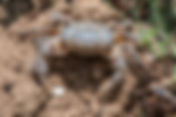
This Freshwater Crab (Potamon fluviatile) is found in or near wooded streams, rivers and lakes in Southern Europe. It is an omnivore with broad ecological tolerances, and adults typically reach 50 mm in size during their 10–12 year lifespan. They have been harvested for food since classical antiquity, and are now a threatened species. Animals Freshwater Crab (Potamon fluviatile) This Freshwater Crab (Potamon fluviatile) is found in or near wooded streams, rivers and lakes in Southern Europe. It is an omnivore with broad ecological tolerances, and adults typically reach 50 mm in size during their 10–12 year lifespan. They have been harvested for food since classical antiquity, and are now a threatened species. Months Seen on Corfu 🟥 Most likely 🟧 Less likely 🟨 Unlikely Jan Feb Mar Apr May Jun Jul Aug Sep Oct Nov Dec 🟨 🟨 🟨 🟧 🟥 🟥 🟥 🟥 🟧 🟧 🟨 🟨 Periods can vary with location and seasonal weather
- Marbled Rock Crab (Pachygrapsus marmoratus)
The Marbled Rock Crab (Pachygrapsus marmoratus) is a species of crab which lives in the Black Sea, the Mediterranean Sea and parts of the Atlantic Ocean. It is dark violet brown, with yellow marbling, and with a body up to 36mm long. The crab feeds on algae and various animals including mussels and limpets. Animals Marbled Rock Crab (Pachygrapsus marmoratus) The Marbled Rock Crab (Pachygrapsus marmoratus) is a species of crab which lives in the Black Sea, the Mediterranean Sea and parts of the Atlantic Ocean. It is dark violet brown, with yellow marbling, and with a body up to 36mm long. The crab feeds on algae and various animals including mussels and limpets. Months Seen on Corfu 🟥 Most likely 🟧 Less likely 🟨 Unlikely Jan Feb Mar Apr May Jun Jul Aug Sep Oct Nov Dec 🟨 🟨 🟨 🟨 🟧 🟧 🟥 🟥 🟧 🟧 🟨 🟨 Periods can vary with location and seasonal weather
- Greek Slow Worm (Anguis graeca)
The Greek Slow Worm (Anguis graeca) is a harmless legless lizard resembling a small snake, measuring up to 50cm. Its smooth, shiny scales are typically brown or grey, sometimes with a hint of bronze. It can be found in Greece's woodlands, gardens, and rocky areas, where it feeds on insects, slugs, and small invertebrates. This lizard is known for its ability to shed its tail to escape predators. Animals Greek Slow Worm (Anguis graeca) The Greek Slow Worm (Anguis graeca) is a harmless legless lizard resembling a small snake, measuring up to 50cm. Its smooth, shiny scales are typically brown or grey, sometimes with a hint of bronze. It can be found in Greece's woodlands, gardens, and rocky areas, where it feeds on insects, slugs, and small invertebrates. This lizard is known for its ability to shed its tail to escape predators. Months Seen on Corfu 🟥 Most likely 🟧 Less likely 🟨 Unlikely Jan Feb Mar Apr May Jun Jul Aug Sep Oct Nov Dec 🟨 🟨 🟨 🟥 🟥 🟧 🟧 🟧 🟥 🟨 🟨 🟨 Periods can vary with location and seasonal weather
- Caspian Whip Snake (Dolichophis caspius)
The Caspian Whip Snake (Dolichophis caspius), also known as the Large Whipsnake, is a common species of whipsnake found in parts of Eastern Europe, including Corfu. It is probably the largest species of snake in Europe and typically grows to around 140–160cm long but may occasionally exceed 200cm. Animals Caspian Whip Snake (Dolichophis caspius) The Caspian Whip Snake (Dolichophis caspius), also known as the Large Whipsnake, is a common species of whipsnake found in parts of Eastern Europe, including Corfu. It is probably the largest species of snake in Europe and typically grows to around 140–160cm long but may occasionally exceed 200cm. Months Seen on Corfu 🟥 Most likely 🟧 Less likely 🟨 Unlikely Jan Feb Mar Apr May Jun Jul Aug Sep Oct Nov Dec 🟨 🟨 🟧 🟥 🟥 🟧 🟧 🟧 🟧 🟧 🟧 🟨 Periods can vary with location and seasonal weather